
Bodhi Borgo
Permanent classrooms
A permanent building for the Plus Two program, planned to open in August 2028, in place of the prefabricated rooms now in use.
Classrooms for Grades 11 and 12
Plus Two is the two years after the Secondary Education Examination: Grade 11 and Grade 12. Bodhi Borgo is the permanent home planned for that program at the Lalitpur campus.
Students in the program will otherwise be taught in prefabricated rooms. Those rooms are an interim arrangement. The new building is intended to replace them when it opens in August 2028.
The figures below are for this plot only. They are not the area of the whole Lalitpur campus.
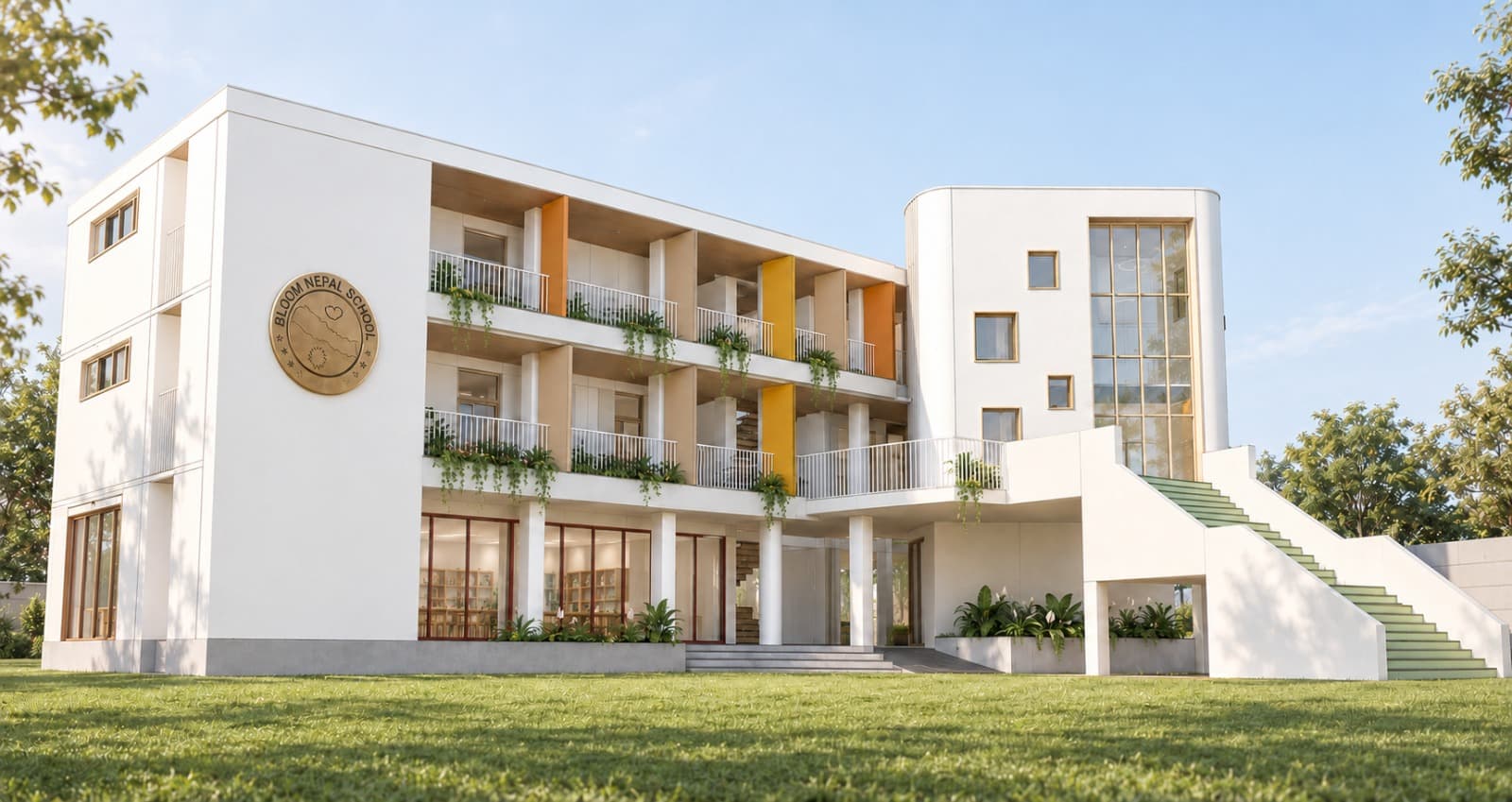
A proposed view of the building. It is a design drawing, not a photograph of finished construction.
Measured areas
Land, footprint, and built-up area as recorded for Bodhi Borgo. Metric figures are conversions of those measurements. One aana is taken as 342.25 square feet, so the land is exactly 21 aana.
Land
7,187.25
sq ft
667.72 m² · 21 aana (1 ropani 5 aana)
Footprint
3,873.55
sq ft
359.86 m² · 53.89% of the plot
Built-up area
7,747.10
sq ft
719.73 m² · twice the footprint
How the three figures relate
The footprint covers 53.89 percent of the plot. The built-up area is exactly twice the footprint, 7,747.10 divided by 3,873.55. Built-up area divided by land is 1.08.
The proposal shows a white classroom block with open balconies and planting along the rails, a glazed ground floor, and a stair tower with a tall window. The school seal is on the front wall. Open balconies and the stair are part of the drawing; they are not automatically included in the built-up figure above.
Who is already behind it
Fundrezzo is the major supporter. Further support is welcome.
Rooms are not named for donors. A supporter may instead be offered an education place for a student of their choice.
A gift is received by Bloom Nepal Foundation. The foundation’s giving page is where a gift is made. How a gift is received is explained on the school site.
August 2028
The building is planned to be in use from August 2028, which is the start of that academic year for Plus Two.
Until then, the program uses prefabricated rooms. Bodhi Borgo is the replacement for those rooms, not an additional campus.
Toastmasters
A path for prepared speeches, impromptu speaking, and listening. Written work is increasingly easy to produce with software. A student still has to stand up and make a case in their own voice. The program has not started. What follows is the plan for starting it.
First year
25
One group of 25 students. That is the workshop size Toastmasters sets for its Youth Leadership Program, and it is the size at which everyone in the room can speak.
The whole school
28
Groups of 25, not one larger meeting. The school has more than 700 students, so full coverage is about 28 groups. A bigger room would mean fewer students actually speak.
First-year cost
USD 250
Paid to Toastmasters International for one Gavel Club. After that, the published renewal is USD 125 a year for the whole club, not per student.
Why the fee stays small
Students under 18 cannot charter an ordinary Toastmasters club. The form Toastmasters provides for them is a Gavel Club. Its published charges are a certification fee of USD 125, paid once, and annual dues of USD 125. Those dues cover the club however many students are in it. The annual term runs from 1 November to 31 October, and renewal is due by 1 November. A club that certifies mid-year pays a prorated first year.
An ordinary club is a different product. It needs 20 members aged 18 or over. Each of them pays USD 144 a year, plus a one-time joining fee of USD 25, and the club pays a charter fee of USD 125. Twenty adult members would cost about USD 3,505 in the first year. The school plan does not use that. One Gavel Club is enough, and a counselor does not have to be a Toastmasters member. The counselor does have to be over 18 and has to follow Nepali rules on staff working with students.
These figures are Toastmasters International’s published fees. They are not a quote from the school, and Toastmasters can change them. Digital officer guides and education materials come with certification. The school provides the room, the teacher, and a timer.
First year
- Appoint one teacher as counselor and reserve a weekly hour in a room that holds 25.
- File the Gavel Club request for certification and pay the USD 250.
- Choose 25 students. Each week the meeting has a presiding officer, prepared speeches, an impromptu speaking round, and evaluations. Students rotate the roles.
- By the end of the year, four or five of them can run that meeting without the counselor speaking for them, and the agenda is written down for the next teachers.
Reaching every student
From the second year, a trained student and the class teacher run a short speaking period in their own class, on the same agenda. The group of 25 stays as the training group. New chairs learn the meeting there, then go back to their class.
Each new class is another 25 speakers. The Toastmasters invoice does not grow with them. What grows is teacher time: one short period a week in each class, using an agenda the first group has already proved.
Putting all 700 students on individual memberships is not the plan. At USD 144 a student, that would be about USD 100,800 a year, and most of them are too young for an ordinary club.
How a sponsor takes part
The gift that opens the program is USD 250, paid so the school can send Toastmasters its certification fee and the first year’s dues. A sponsor who wants to keep it open can add USD 125 for each further year. Because the fee is for the club, that gift covers every student the school later brings into the speaking periods.
The plan is that the club keeps a school name, so it does not depend on one gift. The sponsor is credited when the school writes about the program. A sponsor who already belongs to a Toastmasters club can also evaluate a meeting. Anyone else is welcome to sit in on one.
Write to rijal.ramk@bloomed.org.np if you want to pay the first year, fund a run of renewals, or help the counselor start the group.